
 Français
 Nederlands

In short: a pop-up gazebo must always be anchored, even in calm weather. On grass or soil, drive a stake at each leg and tension straps outwards. On hard ground (tarmac, paving, indoor halls), place a weight at each leg. In strong wind or a thunderstorm, take the tent down: no amount of ballast replaces that rule.
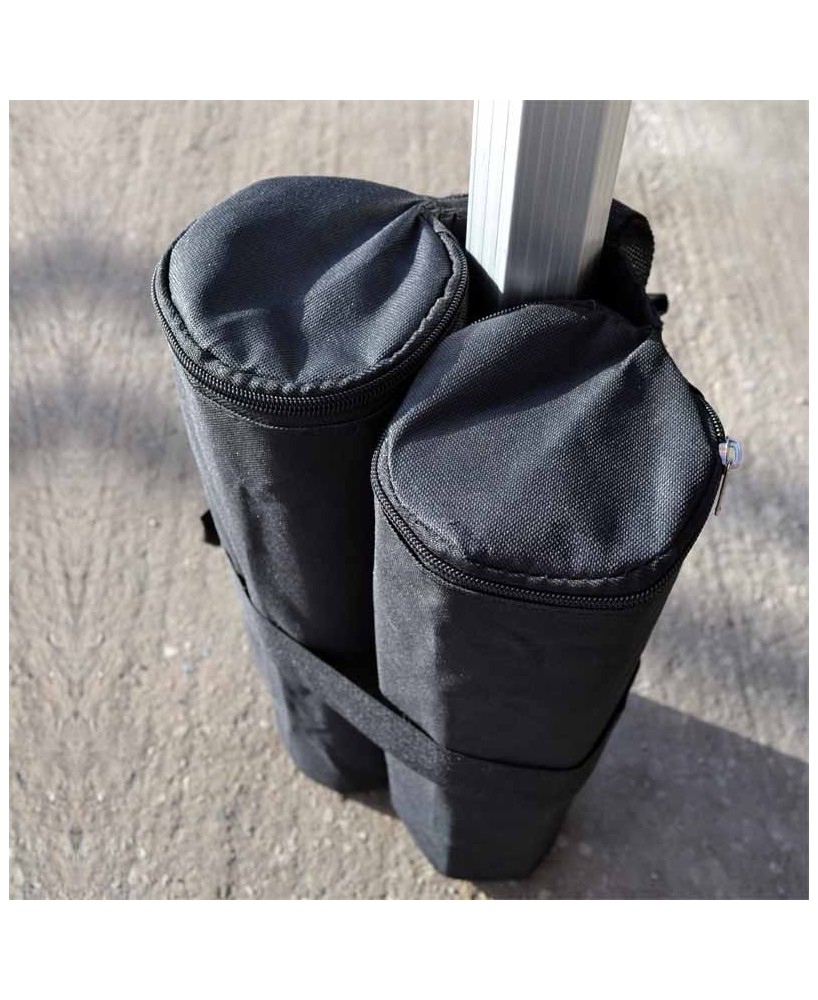
Weight bag attached to a gazebo leg on hard ground.
All the equipment in this guide is available in our gazebo weights and anchoring category.
Why do pop-up gazebos blow away?
A pop-up tent is designed to be light and quick to set up. A professional 3x3 m aluminium gazebo weighs about 45 kg, while its roof presents 9 m² to the wind. That roof acts like a sail: a gust that gets underneath can lift the frame in a second.
Side walls increase wind load even more, especially when one side stays open, as on a market stall or a bar. A tent that takes off can injure visitors, damage nearby equipment and bend its own frame. Anchoring is not optional: it is a safety issue.
Stakes or weights: which anchoring for which ground?
The right system depends first on the surface you set up on.
| Ground | Recommended anchoring | Equipment |
|---|---|---|
| Grass, soil | A stake at each leg and straps tensioned outwards | Anchor kit supplied, heavy-duty stakes with ratchet straps |
| Tarmac, paving, concrete, car park | A weight at each leg | Steel weights or weight bags |
| Indoor hall, tiles, terrace | Weights only (no stakes) | Steel weights or weight bags |
| Exposed site (open field, high ground, seaside) | Stakes and weights combined | Both systems |
| Several tents in a row | Double weights at the joins | Double "H" weight |
On grass or soil: stakes and straps
Our frames come with an anchor kit (stakes and straps). Our assembly manual describes the right method:
- drive a stake at each leg, through the foot plate;
- tension the straps from the corners of the frame to stakes driven at an angle, outside the tent.
For frequent use or an exposed site, the 300 mm heavy-duty stakes with ratchet straps give more tension than a simple guy rope. The ratchet tightens in seconds and keeps the strap taut all day.
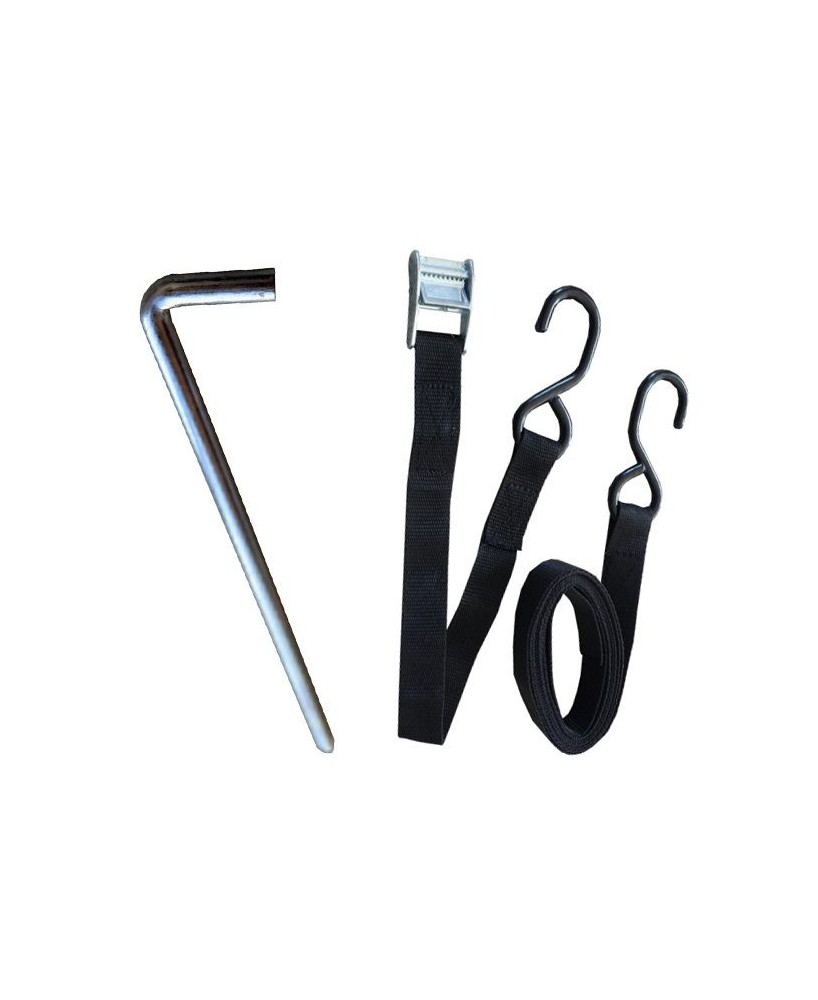
Heavy-duty stake and ratchet strap.
Waterlogged or sandy ground holds stakes less well: in that case, add weights to the legs.
On hard ground: steel weights or weight bags
In a car park, on a pavement, on paving, on a terrace or in a sports hall, you cannot drive a stake. So you weigh down each leg.
- Steel weights: compact and ready to use, they go on in seconds with no filling. Available as a set of 2 x 12 kg weights or 2 x 8 kg.
- Weight bags: made of polyester, they attach to the legs and are filled with sand or plastic water bottles. Empty, they weigh almost nothing in the van. See the set of 4 weight bags, compatible with our Steel, Pro, Pro Plus, Pro Extreme and Composite ranges.
- Double "H" weight: when you set up several tents side by side, the double H weight (15 or 30 kg) holds two legs at once, at the join between two tents.
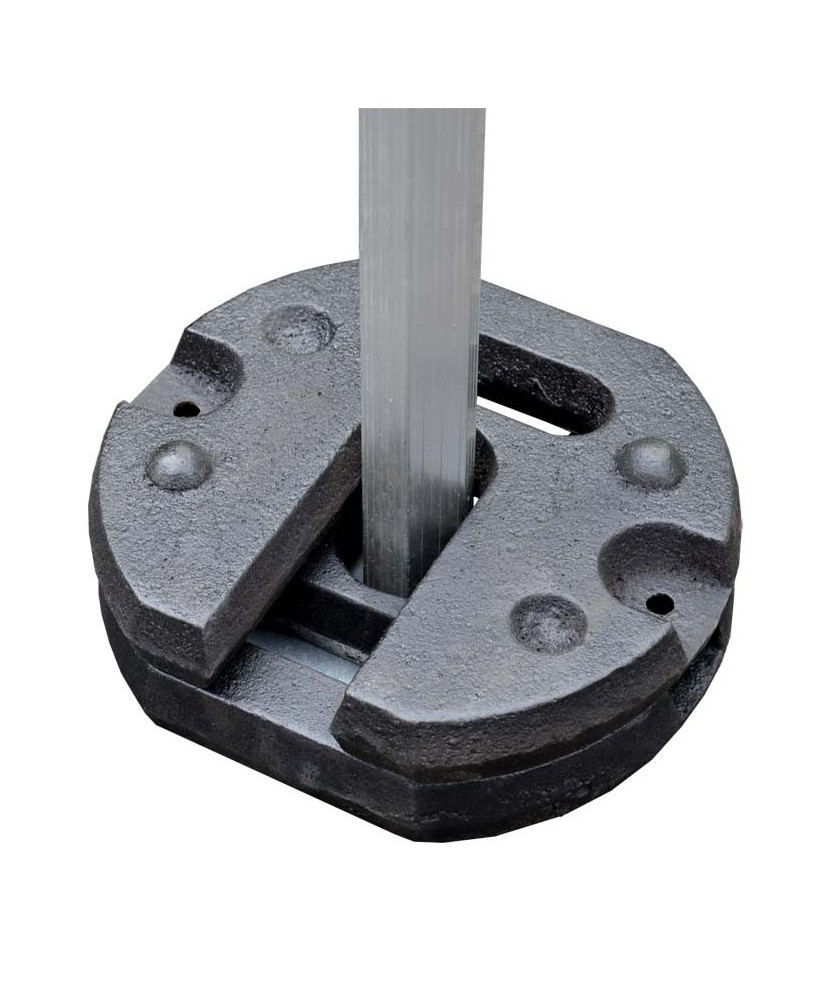
12 kg steel weights stacked at the leg of the tent.
Avoid improvised loads placed loosely (breeze blocks, buckets, crates): they are not attached to the leg, slide easily and trip visitors up.
Equipping a market, a club or a local council? Tell us how many tents, their size and the type of ground: we will advise you on the right ballast. And if you want a tent in your colours, request your free mock-up, sent within 48 hours.
How much weight per leg?
The basic rule: at least one weight at each leg. Three factors then increase the ballast you need:
- size: a 6x3 or 8x4 catches far more wind than a 3x3;
- walls: a tent closed on three sides behaves like a sail;
- exposure: open field, open car park, high ground or seaside.
The guidance published in manufacturers' manuals varies widely: from 15 kg to 60 kg per leg for a 3x3 m tent, depending on the model and exposure. Some manuals halve this weight when the tent is also secured with large stakes. Above all, remember this: if in doubt, add weight. Steel weights can be stacked, as in the photo above, to reinforce an exposed leg.
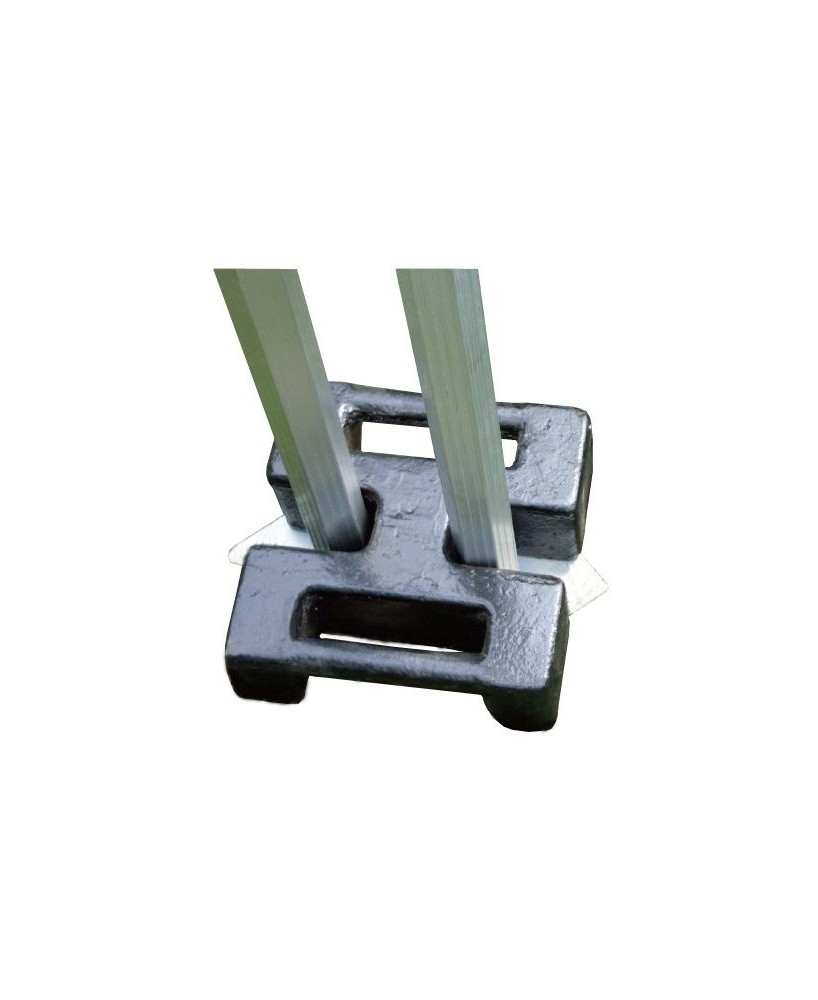
Double "H" weight at the join between two tents.
At what wind speed should you take it down?
Our manual is clear: in strong wind or a thunderstorm, take it down. On the Beaufort scale used by the Belgian Royal Meteorological Institute (RMI), "strong wind" starts at force 6.
| Beaufort force | Description | Mean speed |
|---|---|---|
| 5 | Fresh breeze | 29 to 38 km/h |
| 6 | Strong wind | 39 to 49 km/h |
| 7 | Very strong wind | 50 to 61 km/h |
| 8 | Gale | 62 to 74 km/h |
Many manufacturers' manuals also set the operating limit for a pop-up tent at around 40 km/h. Be careful: the RMI measures mean wind over ten minutes, and gusts are stronger than that mean. Before an event, check the gust forecast on meteo.be in Belgium or Météo-France if you are exhibiting in northern France. If the wind picks up during the day, remove the walls first, then take the tent down.
Good habits during set-up and the event
- Choose flat, clear ground, away from power lines and branches.
- Anchor the tent as soon as it is up, and always before welcoming the public.
- Keep the roof taut: rainwater runs off instead of pooling.
- Check straps and weights during the day, especially after a shower.
- Never leave a tent up unattended if the weather is turning.
- To connect several tents, use joining gutters and double weights.
- At a market or on public land, check with the local council or the organiser: they may set their own safety rules.
Still choosing your tent? Read our guide how to choose a pop-up gazebo: materials, sizes and uses.
Frequently asked questions
How much weight does a 3x3 gazebo need?
At least one weight at each leg. Manufacturers' manuals give guidance of 15 to 60 kg per leg depending on the model and exposure. With walls or on an open site, aim for the top of the range or combine weights and stakes.
Are sandbags enough?
Yes, on hard ground in calm or moderate weather, if there is one at each leg and they are well filled. On an exposed site, add steel weights.
How do I secure a gazebo on a terrace?
On a tiled or wooden terrace, you cannot use stakes: place a steel weight or a weight bag at each leg.
Can I combine stakes and weights?
Yes, it is even recommended on an exposed site or for a tent with walls.
Is the anchor kit supplied with the tent?
Yes, our frames come with an anchor kit (stakes and straps). Weights and weight bags are sold separately.
Need help equipping your tents? We deliver in Belgium and France, within 3 to 4 working days for items in stock. Call us on +32 470 75 38 29: we will advise you free of charge based on your tents and your venues.